
Best Pain Relief for Kidney Stones
CONDITIONS
Written and Medically Reviewed by Mr Ivo Dukic, Consultant Urologist | Last updated: 25/05/2026
What works best for kidney stone pain?
If you are in the middle of a kidney stone attack (renal colic), the single best first-line painkiller is an anti-inflammatory (NSAID) such as ibuprofen, diclofenac or ketorolac — given by mouth, injection or suppository depending on how unwell you are. NSAIDs not only relieve pain better than opioids in most studies, but they also calm the spasm and swelling in the ureter that is causing the pain in the first place [1–3].
If NSAIDs are not safe for you (for example, in kidney impairment, stomach ulcers, or some heart conditions), the next step is intravenous paracetamol, and only then opioids such as morphine as a rescue option [2].
To help the stone pass on its own, the medicine with the best evidence is an alpha-blocker (most commonly tamsulosin), particularly for stones larger than 5 mm and up to 10 mm sitting in the lower (distal) ureter [4].
The rest of this guide explains why — in plain English, with the evidence behind every recommendation.
Living with kidney stone pain in the West Midlands? Mr Ivo Dukic, a consultant kidney stone surgeon and private urologist in Birmingham, sees patients within 7 days at The Harborne Hospital, The Priory Hospital, Spire Parkway Hospital (Solihull) and The Droitwich Spa Hospital. Call 0121 716 9046 or book an appointment. If you have a fever or feel shivery with kidney stone pain, go to A&E straight away.
What is renal or ureteric colic, and why does it hurt so much?
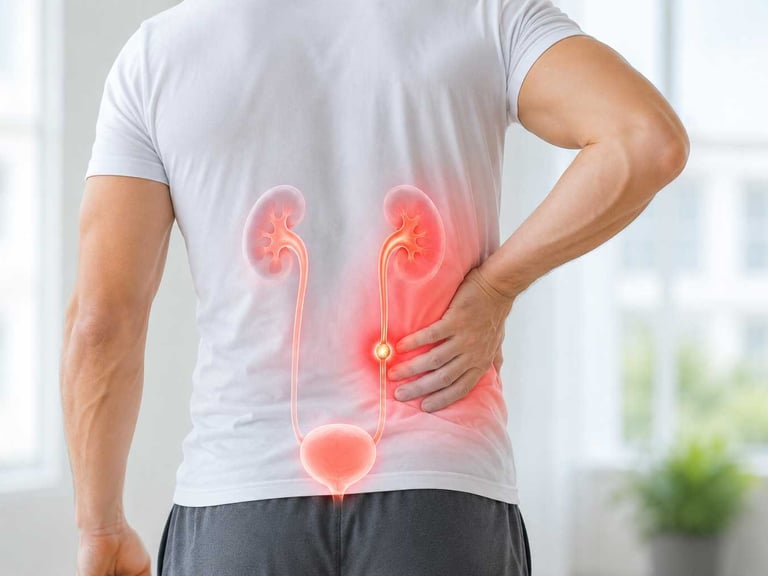
Renal or ureteric colic is the pain caused by a kidney stone moving down the ureter — the narrow tube that carries urine from the kidney to the bladder. The pain comes from two things happening at once:
The ureter is going into spasm as it tries to squeeze the stone forward.
Back-pressure and swelling above the stone, releasing inflammatory chemicals called prostaglandins.
This is why anti-inflammatory medicines work so well: they directly switch off the prostaglandin pathway that drives the pain. Opioids only mask the pain — they do not treat the cause [1,3].
Best painkillers for kidney stones (in order of evidence)
1. NSAIDs — the first-line choice
NSAIDs are the gold standard for acute renal colic. Every major international guideline agrees:
European Association of Urology (EAU) 2025: "Nonsteroidal anti-inflammatory drugs are recommended for first-line pain management, with opioids reserved as a secondary option." [1]
NICE 2019 (UK): "Use an NSAID by any route as first-line. If unsuitable or inadequate, use intravenous paracetamol, then consider opioids. Do not offer antispasmodics." [2]
Urological Association of Asia 2019: NSAIDs have "better analgesic efficacy than opioids" (Level of Evidence 2, Grade A). [3]
Commonly used options include diclofenac, ibuprofen, naproxen and ketorolac. The route (tablet, injection, suppository) matters less than getting it on board quickly.
When NSAIDs are not safe: Avoid or use with caution if you have significant kidney impairment, a history of stomach ulcers or GI bleeding, severe heart failure, are pregnant in the third trimester, or are on anticoagulants. Your doctor will guide this.
2. IV paracetamol — a strong second-line option
If NSAIDs are contraindicated or not enough on their own, NICE recommends intravenous paracetamol next — before opioids [2].
3. Opioids — rescue only
Opioids (morphine, pethidine, oxycodone) remain useful when NSAIDs and paracetamol are insufficient, but they are no longer first-line. They cause more nausea and vomiting, can mask warning signs, and don't address the underlying ureteric spasm [1,2].
4. Antispasmodics — not recommended
Buscopan (hyoscine butylbromide) and similar antispasmodics are not recommended by NICE for renal colic — they do not outperform NSAIDs and add little [2].
Best medicines to help a kidney stone pass on its own
This is called Medical Expulsive Therapy (MET). The aim is to relax the ureter enough that the stone moves down and out without the need for surgery or shockwave treatment.
Alpha-blockers (tamsulosin, alfuzosin, doxazosin)
Alpha-blockers relax the smooth muscle in the lower ureter. Tamsulosin is the most commonly prescribed.
What the guidelines say:
AUA 2026 Guideline (USA): Offer alpha-blocker MET for about 30 days for distal ureteric stones ≤10 mm — Strong recommendation, Grade A evidence [4].
EAU 2025: Alpha-blockers "may be considered for selected patients with ureteral stones" [1].
NICE 2019 (UK): Consider alpha-blockers for distal ureteric stones <10 mm (off-label in the UK), and also as an adjunct after shockwave lithotripsy [2].
UAA 2019: Use alpha-1 blockers (e.g., tamsulosin) for distal ureteral stones >5 mm (LE:1, GR:A) [3].
What the trials show — the honest picture:
The evidence is genuinely mixed, and patients deserve to hear that:
SUSPEND trial (Lancet 2015): A large UK trial of 1,136 patients with ureteric stones ≤10 mm found no difference between tamsulosin, nifedipine and placebo for the rate of stones not needing further treatment within 4 weeks (80–81% in all three groups) [5].
Meltzer trial (JAMA Internal Medicine 2018): A large US trial also found no overall benefit from tamsulosin in a broad emergency department population [7].
Ye trial (European Urology 2017): A very large multicentre trial focused only on distal stones found tamsulosin did improve stone passage (86% vs 79%, p<0.001), with the biggest benefit in stones larger than 5 mm [14].
Cochrane review 2018: Across 67 studies and over 10,500 patients, alpha-blockers were associated with higher stone clearance, shorter time to passage (about 3.4 days quicker), less diclofenac use and fewer hospitalisations [18].
BMJ meta-analysis 2016: Alpha-blockers reduced surgical intervention (relative risk 0.44) and hospital admission (relative risk 0.37) [12].
Cui meta-analysis 2019 (J Urol): Across 56 trials and 9,395 patients, tamsulosin helped stones >5 mm but not stones ≤5 mm [9].
The practical takeaway: Tamsulosin is most likely to help you if you have a distal ureteric stone between 5 mm and 10 mm. For small stones under 5 mm, the natural passage rate is already very high and a tablet may add little.
Side effects to know about: dizziness on standing, low blood pressure, nasal congestion, and retrograde or absent ejaculation in men. These usually settle after stopping.
Silodosin — possibly more effective, but with sexual side effects
A 2015 meta-analysis of 8 trials in 1,048 patients suggested silodosin may pass stones better than tamsulosin, but at the cost of more abnormal ejaculation [17].
Calcium channel blockers (nifedipine) — no longer preferred
Older studies suggested nifedipine helped, but the SUSPEND trial showed no benefit over placebo. NICE and other guidelines no longer recommend it ahead of alpha-blockers [2,5].
Tadalafil (a PDE-5 inhibitor) — emerging but not yet standard
A 2024 meta-analysis of 14 trials suggested tadalafil may match or beat tamsulosin for distal stones under 10 mm, but the studies are inconsistent and tadalafil is not yet in major guidelines for this purpose [11].
What about hydration, heat and "drinking lots of water"?
Drinking enough to keep urine pale is sensible, but there is no good evidence that forcing extra fluids speeds up stone passage. Pushing fluids in someone who is vomiting or in severe pain can backfire. A warm pack on the affected flank can be a genuine comfort while medication takes effect.
When you must see a doctor urgently
Even with the best medicines, kidney stones can become dangerous. Seek urgent medical care if you have:
A fever or shaking chills (possible infection above the stone — a urological emergency)
Pain that is not controlled by NSAIDs and simple analgesia
Persistent vomiting and inability to keep fluids down
Only one functioning kidney, a transplant kidney, or known kidney impairment
Pregnancy
Reduced or no urine output
A stone that has not passed after 4 weeks despite treatment
These situations need imaging, blood tests and often a procedure — not another tablet.
Putting it all together: a sensible plan for acute renal colic
Stop the pain fast: an NSAID by the fastest available route, unless contraindicated. Step up to IV paracetamol, then opioids only if needed.
Confirm the diagnosis: a low-dose CT scan is the gold standard; ultrasound or sometimes an MRI is an alternative, especially in pregnancy and children.
Decide on a trial of passage: for an uncomplicated stone ≤10 mm with controlled pain and no infection, you can usually wait.
Consider tamsulosin (or another alpha-blocker) for around 4 weeks if the stone is distal and 5–10 mm, after a shared discussion about the mixed evidence and side effects.
Stay safe: strain the urine to catch the stone, drink to thirst, and return urgently for any red flag above.
Prevent the next one: once the acute episode is over, ask about stone analysis, a metabolic workup, and dietary advice — recurrence rates without prevention are around 50% at 5–10 years.
Frequently asked questions
Is ibuprofen really better than morphine for kidney stones? For most patients, yes. NSAIDs treat the prostaglandin-driven spasm and inflammation directly, give comparable or better pain relief, and avoid the nausea and sedation of opioids [1–3].
How long does tamsulosin take to work? If it helps, you would usually see the stone pass within 1–4 weeks. Most guidelines suggest a 4-week trial before reassessing [4].
Can I take tamsulosin if I'm a woman? Yes. It is off-label or unlicensed in some countries, but is commonly used. Side effects (dizziness, low blood pressure) still apply.
Will drinking beer or lemon juice pass my stone? There is no good clinical evidence for either as an acute treatment. Stick to evidence-based medicines and adequate hydration.
Can I just wait it out without any tablets? Stones smaller than 4–5 mm often pass on their own. But "without tablets" usually means "without adequate pain control" — and renal colic is genuinely one of the most severe pains in medicine. Take the painkiller.
The bottom line
The best pain relief for kidney stones is an NSAID, given as early as possible, with IV paracetamol and opioids as backup. The best medicine to help a stone pass naturally is an alpha-blocker such as tamsulosin, which is most useful when the stone is 5–10 mm and in the lower ureter. Everything else — antispasmodics, calcium channel blockers, "miracle" drinks — is either unproven or actively not recommended by current guidelines.
If you are reading this in the middle of an attack: take an NSAID if you safely can, and get medical attention — especially if you have a fever, can't keep fluids down, or the pain is uncontrolled.
Why Patients Choose Mr Dukic for their kidney stone surgery:
Expert in Complex Kidney Stone Surgery: Possesses the specialist skill required to manage large, complex, and recurrent kidney stones that other surgeons may not be equipped to treat.
High-Volume PCNL Surgeon: As a high-volume surgeon, he performs a significant number of PCNL procedures annually, a key indicator of proficiency and one of the reasons he is considered amongst the best kidney stone surgeons in the UK.
Pioneer in Minimally Invasive Treatment: Utilises the most advanced, state-of-the-art techniques, including supine PCNL, mini-PCNL and ultra-mini PCNL, to minimise patient recovery time and improve surgical outcomes.
Accessible Across the UK: Based in centrally located Birmingham, West Midlands, he treats patients who travel from across the United Kingdom and internationally for his specialist care.
Rapid Access for Urgent or Ongoing Problems: Whether you are struggling with the discomfort of a ureteric stent, experiencing recurrent pain, urinary tract infections, or blood in the urine related to a kidney stone, or simply facing a lengthy NHS waiting list for surgery, Mr Dukic offers rapid-access appointments — typically within 7 days — so that your symptoms are assessed and a clear treatment plan is in place without delay.
You can schedule an appointment with him for expert, bespoke advice through his Top Doctors profile or book an appointment through Harborne Hospital, HCA Healthcare, the Priory Hospital, Edgbaston, Circle Health Group, Droitwich Spa, Circle Health or Spire Parkway, Solihull.
References
Skolarikos A, Geraghty R, Somani B, Tailly T, Jung H, Neisius A, et al. European Association of Urology Guidelines on the Diagnosis and Treatment of Urolithiasis. Eur Urol. 2025. doi:10.1016/j.eururo.2025.03.011.
NICE Guideline — Renal and ureteric stones: assessment and management. BJU Int. 2019. doi:10.1111/bju.14654.
Taguchi K. The Urological Association of Asia clinical guideline for urinary stone disease. Int J Urol. 2019. doi:10.1111/iju.13957.
Pearle MS. Surgical Management of Kidney and Ureteral Stones: AUA Guideline (2026) Part I: Evaluation and Treatment of Patients With Kidney and/or Ureteral Stones. J Urol. 2025. doi:10.1097/ju.0000000000004842.
Pickard R, Starr K, MacLennan G, Lam T, Thomas R, Burr J, et al. Medical expulsive therapy in adults with ureteric colic: a multicentre, randomised, placebo-controlled trial (SUSPEND). Lancet. 2015. doi:10.1016/S0140-6736(15)60933-3.
Türk C, Knoll T, Seitz C, Skolarikos A, Chapple C, McClinton S. Medical expulsive therapy for ureterolithiasis: the EAU recommendations in 2016. Eur Urol. 2016. doi:10.1016/j.eururo.2016.07.024.
Meltzer AC. Effect of Tamsulosin on Passage of Symptomatic Ureteral Stones: a Randomized Clinical Trial. JAMA Intern Med. 2018. doi:10.1001/jamainternmed.2018.2259.
Seitz C, Liatsikos E, Porpiglia F, Tiselius HG, Zwergel U. Medical therapy to facilitate the passage of stones: what is the evidence? Eur Urol. 2009. doi:10.1016/j.eururo.2009.06.012.
Cui Y, Chen J, Zeng F, Liu P, Hu J, Li H, et al. Tamsulosin as a Medical Expulsive Therapy for Ureteral Stones: A Systematic Review and Meta-Analysis of Randomized Controlled Trials. J Urol. 2019. doi:10.1097/ju.0000000000000029.
Guo Y. The efficacy and safety of mirabegron and α-adrenergic receptor antagonist in the treatment of distal ureteral stones: a systematic review and meta-analysis. Front Pharmacol. 2025. doi:10.3389/fphar.2025.1517979.
Sun F. Pooled-analysis of tadalafil and tamsulosin for ureteral calculi. Front Pharmacol. 2024. doi:10.3389/fphar.2024.1351312.
Hollingsworth JM. Alpha blockers for treatment of ureteric stones: systematic review and meta-analysis. BMJ. 2016. doi:10.1136/bmj.i6112.
Dellabella M, Milanese G, Muzzonigro G. Randomized trial of the efficacy of tamsulosin, nifedipine and phloroglucinol in medical expulsive therapy for distal ureteral calculi. J Urol. 2005. doi:10.1097/01.ju.0000161600.54732.86.
Ye Z, Zeng G, Yang H, Tang K, Zhang X, Li H, et al. Efficacy and Safety of Tamsulosin in Medical Expulsive Therapy for Distal Ureteral Stones with Renal Colic: A Multicenter, Randomized, Double-blind, Placebo-controlled Trial. Eur Urol. 2017. doi:10.1016/j.eururo.2017.10.033.
Wang H. Comparative efficacy of tamsulosin versus nifedipine for distal ureteral calculi: a meta-analysis. Drug Des Devel Ther. 2016. doi:10.2147/DDDT.S99330.
Scales CD. Urinary Stone Disease: Advancing Knowledge, Patient Care, and Population Health. Clin J Am Soc Nephrol. 2016. doi:10.2215/CJN.13251215.
Huang W, Xue P, Zong H, Zhang Y. Efficacy and safety of silodosin in the medical expulsion therapy for distal ureteral calculi: a systematic review and meta-analysis. Br J Clin Pharmacol. 2015. doi:10.1111/bcp.12737.
Campschroer T, Zhu X, Vernooij RWM, Lock TMTW. α-blockers as medical expulsive therapy for ureteric stones: a Cochrane systematic review. BJU Int. 2018. doi:10.1111/bju.14454.
This article is general information based on current published guidelines and trials. It is not a substitute for an individual consultation with your own doctor or urologist. If you think you have a kidney stone, seek medical assessment — especially if you have fever, vomiting, only one kidney, or are pregnant.
Have any questions?


If you have any questions or wish to make an appointment please get in contact.
Ivo Dukic
Contacts
e-mail: admin@ivodukic.co.uk
Telephone number for private patients:
0121 716 9046
(Mondays to Fridays 0800 - 18:00)
For NHS patients seen at University Hospitals Birmingham NHS Hospitals please get in contact on
0121 424 9011
(Mondays to Fridays 0900 - 17:00)
ivodukic.co.uk
© 2026 UrolSurg LTD · Privacy policy


GMC 6103172
BSc MBChB PG Cert FRCSEd (Urol)