
Ureteric Stone Surgery in Birmingham -
Rapid Private Care from a Leading UK Specialist
CONDITIONS
Written and Medically Reviewed by Mr Ivo Dukic, Consultant Urologist | Last updated: 25/04/2026
A ureteric stone is a kidney stone that has passed into the narrow tube connecting your kidney to your bladder. It is one of the most painful conditions a person can experience, and one where delay can cause real harm to the kidney. Mr Ivo Dukic is a consultant urological surgeon and one of the highest-volume stone surgeons in the UK, offering rapid-access private ureteric stone surgery in Birmingham, with a review within days of your first call.
Book a private consultation: 0121 716 9046 · admin@ivodukic.co.uk
What is a ureteric stone?
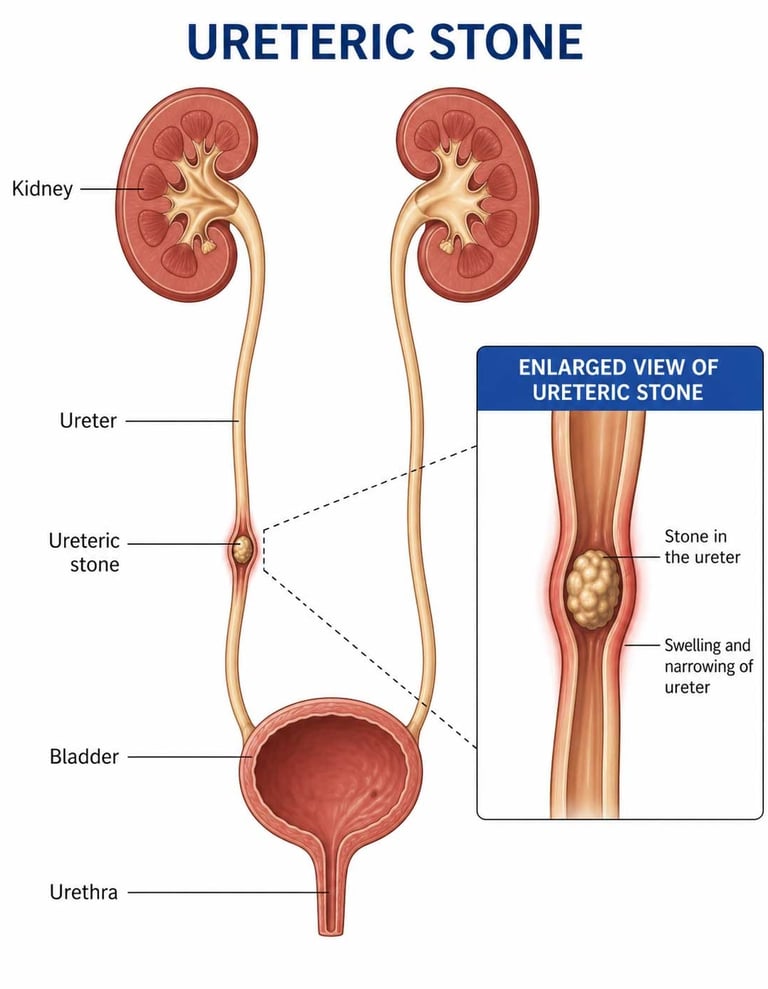
A ureteric stone (also called a ureteral stone or ureteric calculus) is a kidney stone that has left the kidney and become lodged in the ureter, the 25–30 cm muscular tube that drains urine from your kidney into the bladder. Because the ureter is narrow (around 3 mm at its tightest points), even small stones can cause complete obstruction, severe loin-to-groin pain (renal colic), nausea, vomiting and blood in the urine.
Untreated obstruction is not just painful. Within days it can cause:
Kidney function loss on the affected side
Infection behind the stone, which can progress to sepsis
Permanent scarring or strictures of the ureter
This is why ureteric stones are treated as a time-sensitive problem, not a “wait and see” one — especially if you have a fever, reduced urine output, a single functioning kidney, or pain that is not controlled with tablets.
When does a ureteric stone need surgery?
Small stones under around 5 mm often pass on their own with good hydration, analgesia and sometimes an “MET” drug (medical expulsive therapy) such as tamsulosin. However, surgery is generally recommended when:
The stone is larger than 6–7 mm
The stone has not moved after 4 weeks
There is a significant obstruction on a CT KUB scan
You have uncontrolled pain, vomiting or signs of infection
You are in a job (e.g. pilot, HGV driver, surgeon) where an unpredictable stone is not compatible with safe work
You have a solitary or transplant kidney
Ureteric stone treatment options in Birmingham
1. Ureteroscopy and laser (URS) - the gold standard
Ureteroscopy with laser lithotripsy is the most common treatment for ureteric stones and is what Mr Dukic performs most frequently. A fine flexible or semi-rigid telescope (ureteroscope) is passed through the urethra, up into the ureter and onto the stone. A holmium or thulium laser is then used to dust or fragment the stone, and fragments are retrieved with a basket.
Performed under general anaesthetic as a day-case procedure
Success rate for ureteric stones: typically >95% in a single procedure
Most patients go home the same day
A temporary ureteric stent is often (but not always) left for 3–5 days — read about stent symptoms
2. Shockwave lithotripsy (ESWL)
For selected upper ureteric stones, focused sound waves delivered from outside the body can be used to fragment the stone. ESWL avoids general anaesthesia but has a lower single-session success rate than laser surgery and is less suitable for harder stones or lower ureteric stones. The stones also have to visible on X-ray if they are in the ureter so that they can be successfully located to be shocked with the lithotripsy machine.
3. Emergency stenting or nephrostomy
If you present with an infected, obstructed kidney, the priority is to drain the system — usually with an emergency ureteric stent or a nephrostomy tube placed through the back. Definitive stone treatment is then performed once the infection has been controlled, typically 2–6 weeks later.
Why choose Mr Ivo Dukic for private ureteric stone surgery in Birmingham?
Consultant urological surgeon at University Hospitals Birmingham NHS Foundation Trust (the West Midlands’ tertiary stone referral centre)
Fellowship-trained in endourology at the Bristol Urological Institute
One of the highest-volume stone surgeons in the UK
4.98/5 average on Doctify from verified patients
Operates at The Harborne Hospital (HCA), The Priory Hospital (Circle), and Spire Parkway, Solihull
How quickly can you be seen and treated privately?
First consultation within 5–7 days (often sooner)
Imaging (CT KUB, ultrasound) - same day or next day
Ureteroscopy and laser surgery are usually performed within 1–4 weeks of consultation
Follow-up and stent removal 3-5 days after surgery
This is dramatically faster than NHS waiting times for elective stone surgery, which in many trusts currently exceeds 6–12 months for even urgent cases.
How much does private ureteric stone surgery cost?
Self-pay prices depend on the hospital, the anaesthetic, and whether a stent needs to be removed at a second sitting. As an indicative guide for the Birmingham private market:
Initial consultation: from £300
CT KUB imaging: from around £300–£500
Ureteroscopy + laser + stent (day-case): typically £6,000–£9,000 all-in
Stent removal usually on strings and includes as part of surgical fee: from £900–£1,500
0% and low-interest finance is available through our partner hospitals — you can spread the cost over 10, 12, 24 or 36 months
For an exact fixed-price quote for your specific stone, please contact my secretary.
Will my private medical insurance cover the treatment?
Yes. Mr Dukic is recognised by all major UK insurers, including Bupa, AXA Health, Vitality, Aviva, WPA and Cigna. Please have your policy number and authorisation code ready when you book.
What happens next?
Call 0121 716 9046 or email admin@ivodukic.co.uk
Bring any recent scans or GP letters — or ask us to arrange imaging
Meet Mr Dukic, usually within a week
Leave with a clear plan, a fixed price (if self-pay), and a surgery date
Book your private consultation →
Frequently asked questions
How long does a ureteric stone take to pass on its own? Stones under 4 mm pass in around 80% of cases, typically within 4 weeks. Larger stones, stones not progressing on repeat imaging, or stones causing infection or unrelieved pain should not be left.
Is laser ureteroscopy painful? The procedure itself is done under general anaesthetic so you feel nothing. The main discomfort afterwards relates to the temporary ureteric stent if one is used.
Can you remove a ureteric stone without a stent? Yes — in selected cases (small stones, no ureteric swelling, complete clearance), Mr Dukic can perform stent-less ureteroscopy. This is discussed at the consultation.
Is it safe to fly with a ureteric stone? Flying does not cause stones to move but an acute obstruction in flight is a medical emergency with no easy solution at 35,000 ft. Most surgeons, including Mr Dukic, advise treating a symptomatic stone before long-haul travel.
How soon can I return to work after ureteric stone surgery? Most patients with office-based jobs return within 2–5 days (as soon at the stent is out). Patients in heavy manual jobs or with a stent in place may need 1–2 weeks.
Have any questions?


If you have any questions or wish to make an appointment please get in contact.
Ivo Dukic
Contacts
e-mail: admin@ivodukic.co.uk
Telephone number for private patients:
0121 716 9046
(Mondays to Fridays 0800 - 18:00)
For NHS patients seen at University Hospitals Birmingham NHS Hospitals please get in contact on
0121 424 9011
(Mondays to Fridays 0900 - 17:00)
ivodukic.co.uk
© 2026 UrolSurg LTD


GMC 6103172
BSc MBChB PG Cert FRCSEd (Urol)