
Your Virtual Double: How Digital Twins will Revolutionise Medicine
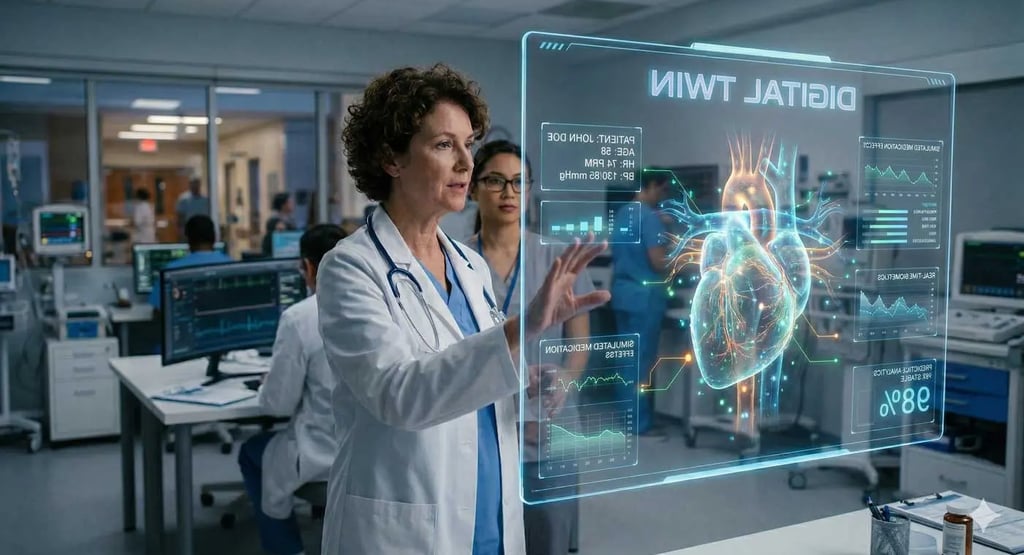
Could a virtual copy of you change the way doctors treat your cancer? Consultant Urologist Ivo Dukic explains how digital twins are reshaping medicine.
Ivo Dukic
5/11/20264 min read
By Ivo Dukic, Consultant Urological Surgeon, Last updated 10/05/2026
Imagine your doctor could test every possible treatment option on a virtual copy of you — your body, your biology, your medical history — before making a single decision about your care. No guesswork. No waiting to see how you respond. Just a precise, personalised plan built around you as an individual, not around an average patient from a clinical trial.
That is the idea behind a digital twin. It might sound like science fiction, but the technology is closer than you might think.
So What Exactly Is a Digital Twin?
The concept actually started in engineering, not medicine. NASA used it to build exact virtual replicas of their spacecraft. Before attempting a repair millions of miles away in space, or putting astronauts at risk, engineers would test their solutions on the virtual model first. If it worked there, they acted. If it didn't, they tried something else — without any real-world consequences.
In medicine, a digital twin works on the same principle. It is a virtual model of you, built from your personal health data — your blood tests, scans, medical history, genetic information, and even results from specialist cancer tests. Crucially, it is not a one-off snapshot. It updates continuously as new information comes in, so it reflects who you are right now, not who you were at your last appointment.
The keyword is personalised. This is not a model of a typical 65-year-old man with prostate cancer. It is a model of you, with your specific biology, your other health conditions, and your individual responses built in.
Why Does This Matter? The Problem With Guidelines
The treatments your doctors recommend are mainly based on clinical guidelines — detailed documents produced by expert panels, drawing on evidence from large research studies involving thousands of patients. These guidelines are an essential part of modern medicine and help ensure that care is consistent and evidence-based.
But there is an inherent limitation. Guidelines are written for groups of people. The research studies they draw on typically include patients who meet very specific criteria — often excluding people with additional health conditions, unusual test results, or rare genetic profiles. By the time a guideline reaches your clinic appointment, it has been written for a population, and your doctor is applying it to an individual: you.
A digital twin flips this around. Instead of asking "what does the evidence say works best for this type of patient?", it asks "given everything we know about this specific person, what is the best course of action for them?" It uses the full weight of medical knowledge — all the research, all the data — but applies it through the lens of your individual biology. That is a fundamentally different approach, and potentially a much more powerful one.
How Could It Help in Surgery and Cancer Care?
One of the most exciting applications is in surgical planning. Before an operation, a digital twin could allow your surgeon to rehearse the procedure on a virtual model of your own anatomy — built from your scans — identifying potential complications and planning the best approach before you ever go near an operating theatre. During surgery itself, a real-time digital twin could highlight the precise edges of a tumour or flag important structures nearby, helping the surgeon work with greater accuracy.
In cancer care, the potential is even more significant. Choosing between treatments — surgery, radiotherapy, drug therapy, active monitoring — is rarely straightforward. A digital twin could simulate how your particular tumour is likely to behave and how your body is likely to respond to each option, giving your clinical team a far more detailed picture than any single scan or blood test can provide on its own.
For prostate cancer specifically, this technology is already beginning to take shape. Advanced artificial intelligence programmes can now analyse MRI scans with a high degree of accuracy, identifying areas of concern that might previously have been missed. These AI tools are not yet full digital twins, but they are an important building block — laying the groundwork for the more complete models that are coming.
What About Other Conditions?
Digital twins are not limited to cancer. In kidney transplantation, a virtual model of a patient could help doctors calculate the right dose of anti-rejection medication from the outset, adjusting it in real time based on how the body is responding — reducing the risk of rejection or drug side effects. In heart disease, digital twins are already being used to decide whether a patient needs a particular procedure before it is carried out.
For urology patients on long-term hormone treatments — for example, men receiving androgen deprivation therapy for prostate cancer — a whole-body digital twin could model the effects of that treatment on the heart, bones, and kidneys simultaneously, helping clinicians manage the broader impact of treatment in a more joined-up way.
Is This Available Now?
Not yet in its complete form — but the foundations are being built. The main challenges are technical, financial, and regulatory. Validating a model that is unique to one individual is genuinely difficult. Ensuring that the artificial intelligence involved does not produce errors that could affect clinical decisions is critical. And the regulatory bodies that approve medical technologies are only beginning to develop the frameworks needed to govern these systems safely.
For now, digital twins will work alongside doctors, providing an additional layer of information to support decision-making — not replacing the clinical judgement and experience that remains at the heart of good medicine.
The Bottom Line
Medicine has always moved towards treating people as individuals rather than statistics. Digital twins represent the most significant step in that direction that technology has yet made possible. The vision — a virtual model of you, continuously updated, helping your clinical team make better decisions at every stage of your care — is both credible and compelling.
We are not there yet, but we are heading there and faster than most people realise.
Mr Ivo Dukic is a Consultant Urological Surgeon based in Birmingham, specialising in kidney stone disease and urological cancer.
Want to Find Out More?
What is a digital twin in healthcare? — Digital Twins for Health: a scoping review (Deng et al., 2024): https://www.nature.com/articles/s41746-024-01073-0
Digital twins and cancer care — CRUK Cambridge Centre on technology improving cancer outcomes: https://crukcambridgecentre.org.uk/news/technology-improved-cancer-patient-outcomes
Digital Twins: From NASA to the Clinic — Full clinical review in Urology News by Ivo Dukic: https://www.urologynews.uk.com/reviews/digital-reviews/post/digital-twins-from-nasa-to-the-clinic
Ivo Dukic
Contacts
e-mail: admin@ivodukic.co.uk
Telephone number for private patients:
0121 716 9046
(Mondays to Fridays 0800 - 18:00)
For NHS patients seen at University Hospitals Birmingham NHS Hospitals please get in contact on
0121 424 9011
(Mondays to Fridays 0900 - 17:00)
ivodukic.co.uk
© 2026 UrolSurg LTD · Privacy policy

GMC 6103172
BSc MBChB PG Cert FRCSEd (Urol)