
A new wave in BPH treatment understanding aquablation therapy
Robotic Aquablation therapy for enlarged prostate (BPH) is now available at The Harborne Hospital, Birmingham. How it works and who it suits.
URINARY SYMPTOMSBPH
Ivo Dukic
12/9/20254 min read
Written and Medically Reviewed by Mr Ivo Dukic, Consultant Urologist | Last updated: 16/03/2026
Aquablation Therapy Birmingham | The Harborne Hospital | BPH Treatment
Revolutionary robotic Aquablation therapy for an enlarged prostate (BPH) is now available at The Harborne Hospital, Birmingham. Experience minimally invasive, heat-free relief with HCA Healthcare UK.
The Enlarged Prostate: Breaking the Compromise
For many men over the age of 50, Benign Prostatic Hyperplasia (BPH)—commonly known as an enlarged prostate—is a frustrating and disruptive condition. Common symptoms include a slow flow, difficulty starting, urgent dashes to the bathroom, and disrupted sleep caused by waking up at night to urinate (nocturia).
Historically, treating BPH has involved a difficult trade-off. Medication often only provides mild relief, while traditional surgeries like TURP (Transurethral Resection of the Prostate), though effective, carry risks of sexual dysfunction, specifically retrograde ejaculation.
Now, as an experienced consultant urologist in Birmingham, I am excited to offer a revolutionary advancement that is changing how we approach bladder outflow obstruction: Aquablation Therapy.
What is Aquablation Therapy?
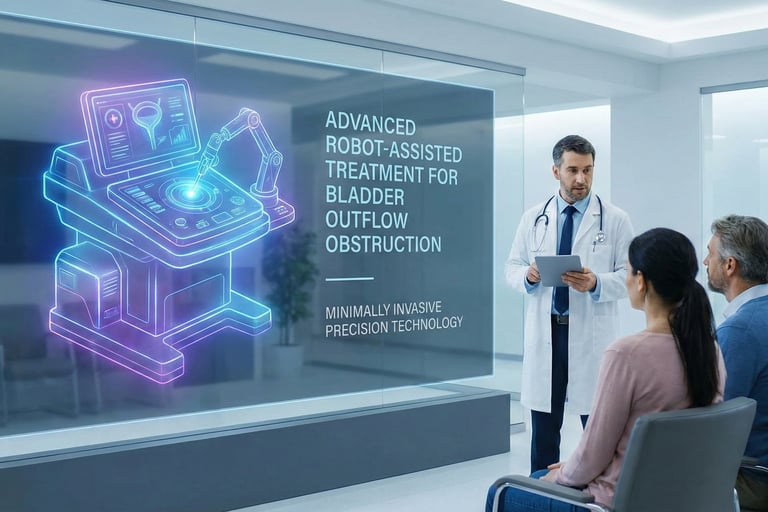
Aquablation therapy is a minimally invasive surgical treatment that uses the AquaBeam Robotic System. It is the first NICE-recommended surgical robot providing autonomous tissue removal for the treatment of BPH.
Unlike other methods that rely on heat (laser prostate surgery) or mechanical cutting (TURP) to remove prostate tissue, Aquablation utilises a high-velocity, heat-free water jet. By avoiding thermal energy, we significantly reduce the risk of damaging the nerves responsible for erectile function and the muscles responsible for ejaculation.
How Aquablation Works: Robot, Water, and Precision
The brilliance of Aquablation lies in its combination of two imaging technologies—cystoscopy (a camera inside the bladder) and ultrasound—orchestrated by a robotic system.
Surgical Mapping: Under anaesthesia, we use an ultrasound probe to gain a live, multi-dimensional view of your prostate. I draw a precise, computerised "map" of the tissue to be removed, carefully avoiding vital areas like the verumontanum (essential for ejaculation) and the external sphincter (vital for continence).
Robotic Resection: Once the plan is locked in, the robot executes it with sub-millimetre precision. A high-velocity water jet sweeps across the mapped area, removing the obstructive tissue. The resection is incredibly fast, often taking less than 10 minutes.
Stopping Bleeding: After the tissue is removed, we use a specialised device to control any mild bleeding. You will typically wake up with a catheter in place, which is usually removed a few days later.
The Advantages: Why Choose Aquablation?
Backed by robust clinical data (the WATER and WATER II studies), Aquablation offers the "best of both worlds"—the symptom relief of aggressive surgery with the safety profile of a minimally invasive procedure.
Preservation of Sexual Function: In clinical studies, Aquablation demonstrated a near-zero risk of erectile dysfunction and a significantly lower risk of retrograde ejaculation compared to TURP.
Consistency and Safety: Robotic execution removes the human-error variable, providing predictable, standardized outcomes.
Versatility for All Sizes: Unlike treatments such as UroLift or Rezum, Aquablation is highly effective for a wide range of prostate sizes and shapes, including those with an obstructive median lobe.
NICE Approved: The National Institute for Health and Care Excellence (NICE) recommends Aquablation as a standard arrangement for treating BPH (IPG770), validating its safety for NHS and private patients.
Who is the ideal patient?
Aquablation is particularly well-suited for men who:
Have moderate to severe urinary symptoms (check you severity) not responding to medication.
Have a prostate that is relatively large (usually 40-50 cc up to 200cc).
Are highly motivated to maintain their ejaculatory and sexual function.
Are looking for a durable, long-term solution rather than a temporary fix.
Understanding the Risks and Recovery
Transparency is key to making an informed medical decision. While minimally invasive, Aquablation does carry some temporary recovery symptoms and low long-term risks:
Temporary Recovery Symptoms (Resolves as you heal):
Burning/Stinging: When passing urine for up to 2 weeks (approx. 1 in 3 patients).
Visible Blood in Urine: May persist for up to 4 weeks (approx. 1 in 4 patients).
Pelvic Pain: Temporary discomfort (1 in 5 patients).
Urinary Tract Infection: May require antibiotics (approx. 6–7%).
Long-Term Risks:
Retrograde Ejaculation: Risk is much lower than TURP, but remains at approx. 10%.
Retreatment: Symptoms may not be fully relieved in a small minority, requiring retreatment within 5 years (4%).
Incontinence / Scar Tissue: Very low risk (approx. 1%).
For more information, please review the NHS Decision Support Tool for Enlarged Prostate
Frequently Asked Questions (FAQs)
How long does it take to recover from Aquablation therapy? Most patients stay in the hospital overnight and have their catheter removed a few days later. You can generally return to light, normal activities within a few days, though you may experience mild burning or blood in your urine for 2 to 4 weeks while the prostate fully heals.
Is Aquablation better than TURP? Aquablation offers similar long-term symptom relief to TURP but with a significantly lower risk of sexual side effects, particularly retrograde ejaculation. Because it uses a heat-free water jet guided by a robot, it is more precise and preserves surrounding nerves better than the heat or scraping methods used in TURP.
Will Aquablation affect my erections? Clinical studies show that Aquablation therapy has a near-zero risk of causing new-onset erectile dysfunction, making it an excellent option for men prioritising the preservation of their sexual function.
Restoring Your Quality of Life in Birmingham
Choosing the right surgery is a highly personal decision based on your anatomy, symptoms, and lifestyle priorities.
If you are struggling with prostate symptoms and have been delaying treatment due to a fear of side effects, it may be time to reconsider your options. I would be happy to review your case and determine if Aquablation is the best pathway for you.
Schedule a Consultation: Mr Ivo Dukic is an experienced consultant urologist offering personalised consultations in Birmingham.
Email: admin@ivodukic.co.uk
Private Patients Telephone: 0121 716 9046 (Mon-Fri 08:00 - 18:00)
Clinics: Harborne Hospital, HCA Healthcare, the Priory Hospital, Edgbaston, Circle Health Group or Droitwich Spa, Circle Health.
References
This article is general information written by Mr Ivo Dukic, Consultant Urological Surgeon (GMC 6103172). It does not replace a consultation with a doctor who knows your history.
Ivo Dukic
Contacts
e-mail: admin@ivodukic.co.uk
Telephone number for private patients:
0121 716 9046
(Mondays to Fridays 0800 - 18:00)
For NHS patients seen at University Hospitals Birmingham NHS Hospitals please get in contact on
0121 424 9011
(Mondays to Fridays 0900 - 17:00)
ivodukic.co.uk
© 2026 UrolSurg LTD · Privacy policy


GMC 6103172
BSc MBChB PG Cert FRCSEd (Urol)