A New Wave in BPH Treatment: Understanding Aquaablation Therapy
Revolutionary robotic Aquaablation therapy for enlarged prostate (BPH) is now available at The Harborne Hospital, Birmingham. Minimally invasive, heat-free relief with HCA Healthcare UK. Book your consultation today.
URINARY SYMPTOMSBPH
Ivo Dukic
12/9/20255 min read
Author: Mr Ivo Dukic, Consultant Urological Surgeon
Estimated Reading Time: 6 Minutes
Aquaablation Therapy Birmingham | The Harborne Hospital | BPH Treatment
The enlarged prostate or prostatic blockage
For many men over the age of 50, Benign Prostatic Hyperplasia (BPH)—commonly known as an enlarged prostate—is a familiar and frustrating problem. The symptoms are well-known: the hesitant flow, the urgent dashes to the bathroom, and the disrupted sleep caused by waking up at night to urinate (nocturia).
Historically, treating BPH has involved a difficult trade-off. Medication often comes with fatigue or dizziness (or worse), while traditional surgeries like TURP (Transurethral Resection of the Prostate), though effective, carry risks of sexual dysfunction, specifically retrograde ejaculation. For years, my patients have asked the same question: "Is there a way to fix my flow without sacrificing my sexual function?"
The answer, increasingly, is yes.
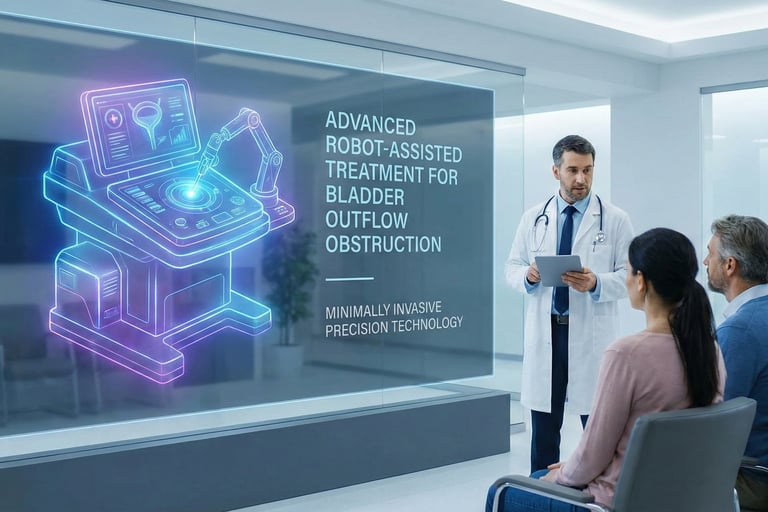
I am excited to be bringing a revolutionary advancement in urology that is changing how we approach bladder outflow obstruction: Aquaablation Therapy. This robotically controlled, heat-free procedure combines real-time imaging with the power of water to provide precise, long-lasting relief with fewer side effects than traditional surgery.
What is Aquaablation?
Aquaablation therapy is a minimally invasive surgical treatment that uses the AquaBeam Robotic System. It is unique because it is the first FDA-approved and NICE-recommended surgical robot providing autonomous tissue removal for the treatment of BPH.
Unlike other methods that rely on heat (laser surgery) or mechanical cutting (TURP) to remove prostate tissue, Aquaablation utilises a high-velocity, heat-free water jet. This distinction is crucial. By avoiding thermal energy, we significantly reduce the risk of damaging the nerves responsible for erectile function and the muscles responsible for ejaculation. However, electrocautery is still used at the end of the procedure to stop any bleeding in safe areas of the prostate.
Robot, Water, and Precision
The brilliance of Aquaablation lies in its combination of two imaging technologies—cystoscopy (a camera inside the bladder) and ultrasound (seeing through the tissue)—orchestrated by a robot. Here is what happens during the procedure:
1. Surgical Mapping
Once you are under anaesthesia, we insert the AquaBeam handpiece into the urethra. The system connects to an ultrasound probe, giving us a live, multi-dimensional view of your prostate. I can see exactly where the obstruction is, but more importantly, I can clearly see the areas we must avoid, such as the verumontanum (vital for ejaculation) and the external sphincter (vital for continence).
On a computer, I draw a precise "map" of the tissue to be removed. This allows for a level of planning that is simply not possible with the naked eye alone.
2. Robotic Resection
Once the plan is locked in, the robot takes over the execution. A high-velocity water jet sweeps across the mapped area, removing the obstructive prostate tissue with sub-millimetre precision. Because the robot executes the plan, the human-error variable is minimised. The resection is incredibly fast—often taking less than 10 minutes of actual ablation time—regardless of the prostate's size.
3. Stopping bleeding
After the tissue is removed, we use a specialised cautery device (loop diathermy) to control any mild bleeding and take away any tissue that could not be safely removed with the robot. You will typically wake up with a catheter in place, which is usually removed the following morning.
The Advantages: Why Choose Aquaablation?
The clinical data backing Aquaablation, specifically the WATER and WATER II studies, have been very compelling. Here is why this treatment is generating such excitement in the urology community:
Preservation of Sexual Function: This is the headline benefit. In clinical studies, Aquaablation demonstrated a near-zero risk of erectile dysfunction and a significantly lower risk of retrograde ejaculation (dry orgasm) compared to TURP. For younger men or those for whom sexual function is a priority, this is a game-changer.
Consistency and Safety: Because the procedure is robotically executed, the results are consistent. The robot doesn't get tired, and it doesn't have a "bad day." This standardisation means we can offer predictable outcomes, whether your prostate is 30ml or 150ml.
Versatility: Many minimally invasive treatments (like UroLift or Rezum) have limits regarding prostate size or shape. Aquaablation is effective for a wide range of prostate sizes and shapes, including those with a median lobe (a part of the prostate that pushes up into the bladder).
NICE Approval: In the UK, the National Institute for Health and Care Excellence (NICE) has updated its guidance (IPG770), recommending Aquaablation as a standard arrangement for treating BPH. This validates its safety and efficacy for NHS and private patients alike.
Potential Risks and Considerations
Temporary Recovery Symptoms. These are common side effects that typically resolve as you heal:
Burning & Stinging: You may experience this when passing urine for up to 2 weeks (affects approx. 1 in 3 patients).
Bleeding in Urine: Visible blood in the urine is common and may persist for up to 4 weeks (affects approx. 1 in 4 patients).
Pelvic Pain: Discomfort in the pelvic area may occur temporarily (affects 1 in 5 patients).
Infection Risks
Urinary Tract Infection: Some patients may develop an infection requiring antibiotics (affects 1 in 15 patients, or 6–7%).
Sexual Function
Retrograde (Dry) Ejaculation: While much lower than traditional TURP, there is still a risk of dry orgasm (Affects 1 in 10 patients, or 10%).
Long-term Risks
Retreatment: In a small number of cases, symptoms may not be fully relieved, requiring further treatment within 5 years (Affects 1 in 25 patients, or 4%).
Incontinence: There is a low risk of urinary leakage (Affects 1 in 100 patients, or 1%).
Scar Tissue: Developing a bladder neck contracture or urethral stricture (narrowing) (Affects 1 in 100 patients, or 1%).
Further information is available from the British Association of Urological Surgeons.
Who is the Ideal Candidate?
Aquaablation is particularly well-suited for men who:
Have moderate to severe urinary symptoms that are not responding to medication.
Have a prostate that is too large for UroLift but who want to avoid the invasiveness of a full TURP.
Are highly motivated to maintain ejaculatory function.
Are looking for a durable, long-term solution rather than a temporary fix.
Making an Informed Decision
Choosing the right surgery is personal. It depends on your anatomy, your symptoms, and your priorities regarding recovery and side effects. The NHS provides an excellent tool to help you weigh these options before you even step into the clinic.
I highly recommend you review the NHS Patient Decision Aid to compare Aquaablation against other treatments like TURP or UroLift:
NHS Decision Support Tool: Making a decision about enlarged prostate (BPE)
This tool will walk you through the pros and cons of each pathway, helping you formulate the right questions for our consultation.
Conclusion
Urology treatments are forever shifting towards smarter, safer, and more patient-centric technologies. Aquaablation represents a significant leap forward, offering the "best of both worlds": the symptom relief of aggressive surgery with the safety profile of a minimally invasive procedure.
If you are struggling with prostate symptoms and have been delaying treatment due to fear of side effects, it may be time to reconsider your options. Technology like the AquaBeam system allows us to tailor treatment to your anatomy and your lifestyle priorities.
Next Step
Are you unsure if Aquaablation is the right choice for your specific anatomy? I would be happy to review your case. Please contact my secretary to schedule a consultation at our Birmingham clinic, where we can discuss your symptoms and determine the best pathway to restoring your quality of life.
Ivo Dukic
Contacts
e-mail: admin@ivodukic.co.uk
Telephone number for private patients:
0121 716 9046
(Mondays to Fridays 0800 - 18:00)
For NHS patients seen at University Hospitals Birmingham NHS Hospitals please get in contact on
0121 424 9011
(Mondays to Fridays 0900 - 17:00)
ivodukic.co.uk
© 2025 UrolSurg LTD